How Phoenix Summer Heat Destroys Garage Door Springs Faster Than Anywhere Else in the Country
Phoenix Summers Are Beautiful. They're Also Quietly Destroying Your Garage Door Springs
Ask any garage door technician working the Phoenix metro area what their busiest season is and the answer is always the same — summer. Not because people suddenly decide to upgrade their doors when the temperature climbs past 110°F. Because that’s when the springs break.
June through September in Phoenix is peak garage door spring failure season. Technicians across Surprise, Peoria, Glendale, and the greater Valley are busier than any other time of year — responding to calls from homeowners whose springs snapped overnight, whose doors suddenly felt impossibly heavy, or whose openers are grinding and straining against a load they were never designed to handle alone.
This is not a coincidence. It is physics. And understanding why it happens is the first step toward making sure it does not happen to you — at least not without warning, and not without a plan.
The Science Behind Spring Failure — Why Metal Fatigue Is Inevitable
To understand why Phoenix heat accelerates garage door spring failure, it helps to first understand how springs fail under normal conditions anywhere in the country.
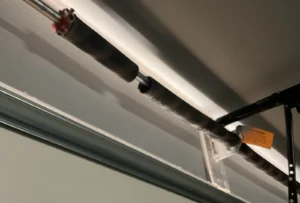
A garage door spring is a precision mechanical component made from hardened steel wire coiled under extreme tension. Its entire purpose is to store and release energy — winding tighter as the door closes, releasing that stored energy as the door opens to counterbalance the door’s weight against gravity. This cycle repeats every single time the door moves. Once up and once down equals one cycle.
With each cycle, the steel wire in the spring experiences what engineers call cyclic stress — a repeated application of force that causes microscopic changes in the metal’s crystalline structure over time. This process is called metal fatigue. It is not caused by poor quality springs or improper installation. It is simply the fundamental mechanical reality of any metal component subjected to repeated stress. Eventually, after enough cycles, the accumulated fatigue reaches a critical point and the spring fractures — usually suddenly, usually loudly, and almost always at the worst possible moment.
Standard builder-grade residential springs are typically rated for 10,000 to 15,000 cycles before metal fatigue causes failure. That is the national baseline. In Phoenix, that baseline is dramatically compressed by factors that simply do not exist in most other American cities.
Four Ways Phoenix's Climate Accelerates Spring Failure
1. Extreme Heat Weakens Metal Faster
Steel is not immune to temperature. At the molecular level, extreme heat causes the metal’s crystalline structure to soften slightly — a property known as thermal tempering. In a garage that reaches 130°F to 150°F on a Phoenix summer afternoon, the steel wire in your torsion spring is experiencing temperatures that gradually reduce its tensile strength and fatigue resistance over time.
Think of it like bending a paperclip back and forth. In a cool environment, you can bend it many times before it snaps. Heat the paperclip first with a lighter and it snaps in far fewer bends. The physics are more complex with hardened spring steel, but the principle is directly analogous. Phoenix heat is doing to your garage door springs what that lighter does to the paperclip — accelerating the fatigue process with every degree of temperature above the moderate conditions the spring’s cycle rating was designed for.
2. Thermal Cycling Creates Constant Expansion and Contraction Stress
Beyond the raw heat, Phoenix’s desert climate creates something that flat-heat environments do not — dramatic daily temperature swings. A garage that sits at 140°F on a July afternoon may cool to 85°F overnight. That 55-degree swing happens every single day during the summer months.
Every time the temperature rises, the steel spring expands microscopically. Every time it cools, it contracts. This repeated expansion and contraction — called thermal cycling — creates stress in the metal’s structure at a molecular level that is entirely separate from the stress generated by opening and closing the door. In effect, Arizona springs are experiencing fatigue stress from two independent sources simultaneously: mechanical cycling from door operation and thermal cycling from the climate. Springs in Phoenix are aging on two clocks at once while springs in, say, San Diego are only aging on one.
3. Monsoon Humidity Introduces Corrosion
Arizona’s monsoon season — running roughly from mid-June through September — introduces brief but significant humidity spikes into an otherwise dry climate. For garage door springs, this matters because surface corrosion is one of the most significant accelerators of metal fatigue. Even minor surface rust on a spring’s coils creates microscopic stress concentration points — tiny irregularities in the surface where fatigue cracks initiate and propagate faster than they would on a clean, smooth surface.
A spring in Phoenix that has survived several monsoon seasons without proper lubrication and maintenance is carrying corrosion-related fatigue damage that is invisible to the naked eye but very real in terms of its remaining service life. This is one of the key reasons why professional annual maintenance is not optional in Arizona — it is genuinely protective.
4. Dust and Debris Increase Friction and Wear
Phoenix’s dust storms — haboobs — are spectacular to watch from a safe distance and genuinely damaging to mechanical systems. Fine dust particles infiltrate every gap and crevice in a garage, including the coils of the torsion spring. Dust accumulation on a spring creates friction during winding and unwinding that both increases the stress on the metal and, over time, acts as an abrasive that degrades the spring’s surface.
This effect is amplified if the spring has not been professionally lubricated. A well-lubricated spring sheds dust more effectively and the lubricant film provides a protective barrier against the abrasive action of fine particulate. A dry, unlubricated spring in a dusty Phoenix garage environment is experiencing accelerated surface wear with every single cycle.
How Much Shorter Is a Spring's Lifespan in Phoenix?
This is difficult to quantify with scientific precision because it depends on a combination of factors — garage insulation, specific door usage patterns, spring quality, maintenance history, and the specific microclimate of the property. However, based on the conditions described above, Phoenix area homeowners should realistically expect their springs to fail meaningfully earlier than the national average cycle ratings suggest.
A spring rated for 10,000 cycles in a moderate climate may effectively deliver 7,000 to 8,000 cycles of reliable performance in a Phoenix garage before signs of fatigue begin to emerge. For a household that operates the door four times per day, the difference between 10,000 and 7,500 effective cycles is approximately four and a half years versus six and a half years of expected service life. That is a two-year gap on a component whose failure locks you out of your garage, potentially damages your opener, and sometimes creates a safety hazard.
This accelerated reality is exactly why upgrading to a high-cycle spring system matters more in Phoenix than it does almost anywhere else in the country. A spring rated for 50,000 cycles in a national average environment still delivers dramatically longer service life in Phoenix even accounting for the climate penalty — because the starting point is so much higher.
Warning Signs Your Springs Are Approaching Failure
The challenging reality of garage door spring failure is that it often happens without much warning. However, there are signs that an attentive homeowner can watch for that indicate a spring system is approaching the end of its service life.
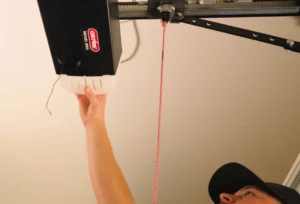
The door feels unusually heavy when lifted manually. Disconnect your opener by pulling the red emergency release cord and try to lift the door manually from the bottom. A properly balanced door should feel nearly weightless and stay in place when lifted to about waist height. A door that feels heavy, drops when you let go, or requires real effort to lift is telling you its springs are losing tension and approaching failure.
The door opens unevenly or crookedly. If one side of the door rises faster than the other, or if the door appears to tilt as it moves, this often indicates that one spring has lost tension faster than its counterpart — a common precursor to imminent failure.
Visible gaps or separation in the spring coils. A broken or severely fatigued spring will sometimes show a visible gap where the coils have separated. If you can see a gap, the spring has already failed or is on the verge of doing so.
Unusual sounds during operation. A grinding, squeaking, or creaking sound coming from the spring area during door operation can indicate inadequate lubrication, corrosion, or coil deformation. Any unusual sound from the spring assembly warrants a professional inspection.
The opener is straining noticeably. If your <a href=”https://garagedoorgrunts.com/garage-door-openers/garage-door-opener-repair/”>garage door opener</a> sounds like it’s working significantly harder than usual — slower movement, louder motor strain, hesitation at the start of the opening cycle — the opener may be compensating for springs that are no longer providing adequate counterbalance.
What Can Phoenix Homeowners Do to Protect Their Springs?
There are three meaningful actions Phoenix homeowners can take to protect their spring systems and extend their useful service life.
Lubricate the springs annually — or have it done professionally. A proper garage door lubricant applied to the spring coils once per year creates a protective film that reduces friction, inhibits corrosion, and helps shed dust. Our annual tune-up service includes spring lubrication as a standard component.
Invest in a high-cycle spring system when it’s time to replace. When your current springs reach end of life, choosing a high-cycle spring system over a standard replacement is the single most impactful upgrade you can make in a Phoenix climate. The cost difference between a standard spring and a 50,000-cycle high-cycle spring is meaningful but not dramatic — and in Arizona’s climate it delivers proportionally greater value than it would in a more moderate environment.
Schedule annual professional maintenance. A trained technician can assess spring condition, cable wear, roller degradation, and hardware tightness in a single visit and identify components approaching end of life before they fail.
Our Grunt Guard Security Plan at $29.95 per month includes an annual professional tune-up, no trip fees during normal business hours, and 10% off all parts and labor — making it one of the most cost-effective ways to keep a Phoenix garage door system properly maintained year-round. Ask our team about enrollment when you call or during your next service visit.
What Does Spring Replacement Cost in Phoenix?
At Garage Door Grunts, all spring replacements is priced on a flat rate basis — parts and labor included, no hidden fees, no surprise charges when our technician arrives.
We replace springs in pairs on a two-car door, because the second spring is the same age and carries the same wear. A standard double-spring replacement is $395 installed, backed by a 2-year guarantee. High-cycle upgrades, Wayne Dalton conversions, and our Signature Moving Parts Kit are available at tiered price points depending on the spring grade and warranty coverage selected.
Financing is available on qualifying projects starting at $500.
Don't Wait for the Bang
A garage door spring failure is not subtle. The sound of a torsion spring snapping under tension — a sharp, loud crack that reverberates through the garage and into the house — is something homeowners remember clearly. It happens at random, often in the middle of the night or early morning, and it always results in a door that will not open until the spring is replaced.
In Phoenix, where summer temperatures make a car left outside genuinely uncomfortable and where the garage is often the primary entry point to the home, that failure is more than an inconvenience. It is a disruption that an annual professional assessment could often have predicted and prevented.
We serve homeowners across Surprise, Peoria, Glendale, Goodyear, Buckeye, Sun City, Scottsdale, Anthem, and throughout the greater Phoenix Valley. Available 24 hours a day, 7 days a week — no after-hours fees, ever.
Schedule Service Today or call us directly at (623) 219-8460. Flat rate pricing. Veteran owned. No surprises.