There is a specific sound a torsion spring makes when it lets go. People describe it as a gunshot, or a car hitting the house. If you heard it, and now your door will not move, you are in the right place.
We run these calls every week out of our shop in Deer Valley. Doors stuck halfway. Doors stuck wide open at eleven at night with the whole garage on display. Doors sitting flat on the ground with somebody’s car behind them and a shift starting in six hours. Almost all of them come down to the same handful of failures, and a few of them get noticeably worse in the ten minutes right after they happen, because the natural reaction is to keep pressing the button.
So: what to do right now, what probably broke, what it costs, and how to tell whether it can wait until morning.
First, Stop Pressing the Button
If the door moved a few inches and stopped, or it groaned and quit, or it went up crooked and jammed, take your hand off the remote.
A garage door is not a light switch. It is a counterbalanced system, and the opener is the smallest, weakest part of it. The springs do the lifting. The opener only nudges. When a spring breaks, that nudge is suddenly being asked to drag 150 to 250 pounds of dead weight up a track, and it will try, because it does not know any better.
It is also the largest moving mechanical object in your home, and one of the most dangerous when something in it has failed. Worth holding onto for the next ten minutes.
What That Loud Bang Was
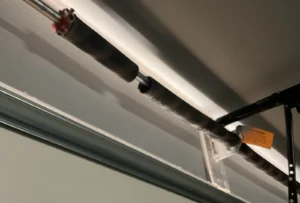
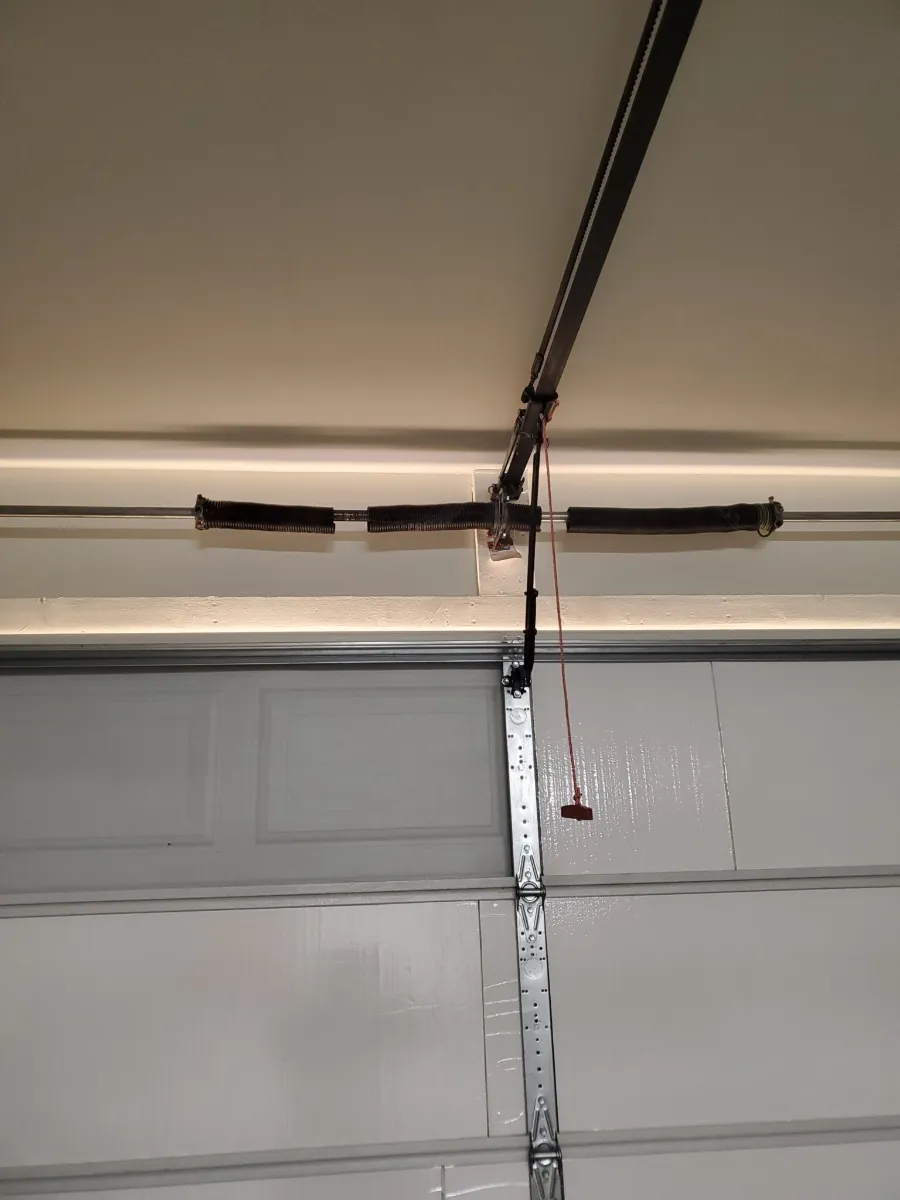
Nine times out of ten it was a torsion spring, the bar-mounted coil that sits above the opening on a steel shaft. They are wound under enormous tension. When the metal finally fatigues, the coil unwinds in a fraction of a second and slams against the shaft. That is the noise.
Look up at the bar above your door. If you see a clean gap in one of the coils, like somebody cut it with a saw, that is your answer. The door itself is fine. The thing that carries it is not.
Why Hitting the Remote Again Makes It Worse
Every extra cycle you force after a break is doing damage somewhere else:
- The opener gear. Most residential openers have a nylon drive gear that is designed to strip rather than burn out the motor. Force enough dead weight through it and you turn a spring job into a spring job plus an opener repair.
- The cables. With one spring gone, the load goes uneven. Cables slip off the drums, fray, and snap.
- The door itself. A door dragged up crooked binds in the track, bends a hinge, and creases a panel. Panels are the expensive part.
One press to confirm it is dead is reasonable. Ten is how a $395 repair becomes a $1,200 one.
If Your Car Is Trapped, Here Is How to Get It Out
This is the part people actually call about at midnight, and there is a right way and a genuinely dangerous way to do it.
The Red Cord, and When to Pull It
That red handle hanging off the trolley near the ceiling is the manual release. It disconnects the door from the opener so the door can be moved by hand.
If your door is already all the way down, it is safe to pull. Give it a firm tug straight down, then lift the door by hand. If a spring is broken you will feel it immediately: instead of gliding, it feels like deadlifting a loaded appliance dolly. If it will not move with a solid effort from a good stance, stop. It is not going to.
When NOT to Pull the Manual Release Cord
Safety: if the door is stuck partway up, or all the way open, and you suspect a broken spring, do not pull the release. This is the one that hurts people.
With the spring intact, the door is balanced and stays where you put it. With the spring broken, the only thing holding that door up is the opener’s trolley. Release the trolley and there is nothing left. A 200-pound door can come down the track fast and land on whatever is under it, which is often the hood of the car somebody is trying to rescue.
If your door is up and you think a spring let go, leave it up. Call somebody. A stuck-open garage is a security problem, not a physics problem, and a security problem can be managed for a few hours.
Getting the Door Back on the Opener
Once the door is repaired, reconnecting is usually just running the opener through one cycle — the trolley catches the carriage on its own. If yours has a spring-loaded lever instead, you pull the cord toward the door to re-engage. If the trolley will not catch, that is worth mentioning when you call, because it sometimes points at a bent rail rather than the release itself.
The 5 Most Common Causes of a Stuck Garage Door
Five failures cover the overwhelming majority of stuck-door calls we run across Phoenix.
1. A Broken Torsion Spring
The most common by a wide margin. A standard spring is rated somewhere around 10,000 cycles. A cycle is one trip up and one trip down, so a family with two cars and a couple of teenagers can burn through four to six cycles a day without thinking about it. That is roughly seven years of life on paper, and less than that here.
Springs are replaced in pairs. Not because anybody is upselling you, but because the second spring is the same age, has the same cycle count, and is usually weeks or months behind the first one. Replacing one means paying a second trip charge shortly after. We use oil-tempered springs rated for Arizona heat and back them for two years. Broken spring replacement is the single most common job on our board.
2. A Snapped Lift Cable
The cables run from the bottom bracket up to the drums at either end of the spring shaft. They fray from the inside out, usually at the drum, and they rarely go without warning — you get a period of the door running slightly crooked first.
When one snaps, that corner drops and the door goes diagonal in the track. If you catch it early it is a straightforward cable replacement. If you keep cycling it, the door comes off track and takes a panel with it.
3. The Door Came Off Track
Backing into a door does this. So does a snapped cable, a worn roller, or a bent track that has been quietly getting worse. The door sits crooked, wedged, sometimes visibly hanging out of one side.
Do not try to lever it back in. The rollers are held by hinges under load, and a door that is off track on one side has weight sitting where it was never designed to sit. Track repair and re-tracking is a two-person job with the right clamps.
4. The Opener Motor Died
If the door is closed, the wall button does nothing, and there is no hum from the motor, start with the boring stuff. Check that the opener is plugged in. Check the breaker. Monsoon storms take out garage circuits constantly, and we have driven across the Valley to flip a breaker more than once.
If the motor hums but nothing moves, the drive gear is usually stripped. If it runs and the chain moves but the door does not, the trolley has disconnected — see the red cord above.
5. A Blocked or Bumped Photo-Eye Sensor
If your door closes partway and reverses, or refuses to close but opens fine, look at the two small sensors near the floor on either side of the opening.
They have to see each other. A bike leaning in the wrong spot, a bag of mulch, a spider web, or a knock from a car door that rotated one sensor a few degrees will stop the door from closing. Most have a small LED — if one is off, flickering, or a different color than the other, that is your problem. Wipe the lenses and check the alignment before you call anybody. In Phoenix, dust film on the lenses is a genuinely common cause, and it costs nothing to rule out.
What Garage Door Repair Costs in Phoenix
Most companies will not put a number on a page. We will, because the number is usually not the problem — the surprise is.
The Standard Service Call Fee
$49.95, and it is waived on any repair over $200. That covers the trip and a full inspection of the system, not just the part that failed. Since most stuck-door repairs land above $200, most customers never actually pay it.
Emergency and After-Hours Callouts
Our technicians work 8 a.m. to 6 p.m. Our phones are answered 24 hours a day. Those are two different things and the difference is where the money is.
Calling us at 2 a.m. costs nothing. Somebody real picks up, gets your details, and puts you on the board. What triggers the $250 flat emergency callout is dispatching a technician outside those working hours — and that includes early mornings, because pulling someone out before 8 is the same disruption as a midnight call.
We tell you which side of that line you are on before we roll, not after. If your door can safely sit until the crew is already running, you pay the standard $49.95 instead and we will say so.
What a Spring Job Runs
Double-spring replacement starts at $395 installed — both springs, oil-tempered, rated for the heat, two-year guarantee. Cables, rollers and opener work vary with the hardware, and you get the number before we start, not on the invoice.
Worth knowing: a $129.95 tune-up is one of the least expensive ways to make sure an emergency like this never happens to you in the first place. It is the visit that catches the frayed cable and the tired spring before either one strands you.
When It Can Wait Until Morning, and When It Can’t
Honest triage, because not every stuck door is an emergency.
It can usually wait if:
- The door is closed and secured, and nobody needs the car before 8 a.m.
- The opener is dead but the door itself is sound and you can operate it by hand.
- The door closes fine and only the remote or keypad is misbehaving.
Call for after-hours dispatch if:
- The door is stuck open. An open garage at night is an unlocked door into your house.
- A car you need is trapped and the door will not safely open by hand.
- The door is hanging crooked, off track, or leaning. That is unstable and it can come down.
- A cable has snapped and the door is partway up. Same reason.
If you are not sure, describe what you are looking at when you call. We would rather talk you out of a $250 callout than take one you did not need.
Why August Is the Worst Month for a Stuck Garage Door in Phoenix
There is a reason our board fills up between June and September.
Steel loses temper under sustained heat, and a garage that sits past 110 degrees for weeks at a time ages a spring faster than the same spring would age almost anywhere else in the country. We broke that down further in our guide to garage door spring replacement in Phoenix. On top of that, the daily swing between a 115-degree afternoon and a 30-degree-cooler night has the metal expanding and contracting every single day. Fatigue is cumulative, and Arizona simply gets more of it per year.
Then monsoon adds three things at once. Blowing dust settles on photo-eye lenses and into roller bearings, where it works like grinding paste. Wind pressure flexes the door in the track. And the power surges that come with a storm cell take out opener logic boards — that is a call we run in clusters, several in a day, after a bad night.
None of that is avoidable. It is just the trade here. It is also why nylon rollers rated up to 100,000 cycles are worth the small upgrade over the stock plastic ones, and why a door that gets looked at once a year tends not to be the one stranding somebody in August.
We cover this across the whole Valley — Deer Valley, Desert Ridge, Norterra, Moon Valley, Sunnyslope, Paradise Valley Village, Ahwatukee and out to Anthem and Cave Creek. If you want the full picture on coverage, response times and pricing, that lives on our Phoenix garage door repair page. If your door is stuck right now and you are past business hours, emergency garage door repair has the after-hours details.
Frequently Asked Questions
Stop pressing the button. Every extra cycle after a failure risks stripping the opener gear, slipping a cable off its drum, or bending a panel. If the door is stuck partway up and you suspect a broken spring, do not pull the red emergency release either, because the opener trolley may be the only thing holding the door up.
It is safe when the door is already all the way down. Pull it firmly and try lifting the door by hand. It is not safe when the door is stuck partway up or fully open with a broken spring, because releasing the trolley can let a 150 to 250 pound door drop down the track onto whatever is underneath it.
Our technicians work 8 a.m. to 6 p.m. and our phones are answered 24 hours a day. Calling after hours costs nothing. Dispatching a technician outside those working hours, including before 8 a.m., is a flat $250 emergency callout that we quote before we roll. If the door can safely wait for the regular crew, you pay the standard $49.95 service fee instead, and that fee is waived on any repair over $200.
Double-spring replacement starts at $395 installed. That covers both springs, oil-tempered and rated for Arizona heat, with a two-year guarantee. We replace springs in pairs because the second spring has the same age and cycle count as the one that broke and is usually not far behind it.
A standard torsion spring is rated around 10,000 cycles, which is roughly seven years of average use. Sustained heat in an uncooled garage and the daily swing between a very hot afternoon and a much cooler night both accelerate metal fatigue, so Valley springs commonly fail earlier than that rating suggests.
Usually not. A door that opens fine but reverses on the way down is almost always a photo-eye problem. The two sensors near the floor have to see each other. Check for something blocking the beam, wipe dust off both lenses, and look at the small indicator lights. If one is off or flickering, the sensor has been bumped out of alignment.
What to Do Next
If your door is stuck as you are reading this, here is the whole thing in four lines.
Stop pressing the button. If the door is down, you can safely pull the red release and try lifting by hand. If the door is up and you think a spring broke, leave it alone and leave it up. Then call, and tell whoever answers what you are looking at — closed or open, crooked or straight, whether you heard a bang, and whether a car is stuck behind it.
That last part matters more than people expect. Half of what we are deciding on the phone is whether you need somebody tonight at the $250 callout or whether you are fine until morning at $49.95, and we can usually tell from a good description.
We are a Marine veteran-owned shop working out of Deer Valley. The family has been in this trade for more than 25 years and Garage Door Grunts has been running its own trucks since 2021. Some companies advertise a free service call and make it back on the parts price. We charge $49.95, waive it on any repair over $200, and show you the number before anything gets touched. That is the whole pitch.
Whatever broke, it is almost certainly something we replaced last week. Browse all garage door repairs, check this month’s current offers, or get on the schedule below.